
Earlier this Fall, my brother and I checked off a bucket list item: going to our first Imagine Dragons concert. We road-tripped out to middle-of-nowhere Missouri with a plan for my brother to drive us through the night so I could make it back home in time to teach my 8am class the next morning. Classic sibling adventure, right there. The venue was incredible: a stage on the edge of a mountain, nothing but rolling green hills in sight for miles behind the stage. The weather couldn’t have been more perfect, too: a hint of coolness in the air, not always a guarantee for September. And the concert itself? It was an absolute blast, full of music I knew and could sing and dance along to. All in all, it was a very satisfying fulfillment of a long-time dream to see one of my favorite bands in concert.
But, on the way back to the car, my brother said, “That was fun, but I also felt sad for them.”
I agreed. The reason we felt sad for them? It has to do with Hope.
You see, the Imagine Dragons concert’s main message was: “Everything’s going to be okay,” a message meant to speak encouragement to those struggling, especially with mental health. While that message is positive and uplifting, at least in part, my brother and I both picked up on the same thing: how hollow that hopeful message felt, how hope without a true base can’t sustain you, and how messages of hope apart from the Gospel fall flat. Because life itself shows us we shouldn’t have hope; even when there are ups, life always brings an inevitable downward slope. It’s certainly okay to be positive or optimistic about the future, but in the end, a message about hope split from the Gospel isn’t real hope—it’s only a short-term band-aid. It’s only in Christ where hope does not fail, where we can truly know that, in the end, everything will be okay and restored and renewed, because in Christ, not even Death has the final word.
Interestingly, the Imagine Dragons concert isn’t the only place that’s challenged me to think about hope. This whole year seemed to be centered on this theme, this aspect of the Gospel and God’s character, especially since I’ve struggled deeply to feel hopeful many times this year.
In fact, hope—and specifically the lack of it—seems to be a major theme in our world at large. We see the chaos of the world, and it’s easy to fall into despair. Confusion. Uncertainty. Suicide rates are up, as are depression and anxiety. We put hope in politicians who don’t get elected or who don’t fulfill their promises. This last election cycle especially yielded a lot of posts full of despair and a lack of hope for the future, which went beyond mere disappointment in the outcome.
As for me, I also have struggled to feel hopeful on personal dreams, things that I see as good and I’m slowly learning to disentangle from the eternal promises of my faith in Jesus. Specifically, I’ve struggled to feel hope about marriage, education, and my future career. This also feels really difficult to admit. After all, I live in the most prosperous time in history, in the most prosperous country in the world, where I have so much freedom and ability to move forward that so many others don’t have. Why should I feel hopeless? Why do I still want more than the blessings the Lord has already given me? My hopelessness reveals the lies of the Enemy and his deception at work, partnered with the deception of my own heart and the power of my idols. 2024 has been a year marked by recognizing these sins and by God reminding me that hoping in Him is never in vain. From Bible Study to Women’s Gatherings to time in prayer, God has restored my hopefulness, especially my hopefulness in Him.
But what’s also incredible—and something I only realized as I wrote this post—is that as I’ve pressed more into hoping in the eternal truths of God, He has also restored my hope in those smaller dreams, those good things not promised to me, but I have deeply struggled to be optimistic about this year. I had hoped the new university I am currently attending for my doctoral program would be better than my previous one—and it is. It was not the school I really, really wanted to get into, but I see the Lord’s hand in leading me here. I also hoped that moving and attending a new church would open up new opportunities to meet a potential husband. While nothing concrete has developed on that front, I do feel more positive about marriage one day happening for me. And I entered this new season hoping that I would once again be consistent and productive and enjoy writing my novels. And guess what? I am on track to finish my second novel within six months by the end of this year. That’s crazy!
I do have to be honest and admit, though: this is retrospection. It is easy (and good) to look back and see how things have played out, but in the day to day, I have to fight for hope, and specifically fight to put my hope in the right things (or should I say “Right King?”). The days when I’m most concerned about the long-term plans for my writing, or most preoccupied with my singleness, tend to be the days when I am least focused on the Lord.
And truthfully, I don’t know what will come of my small dreams. I don’t have a guarantee that my doctoral university will continue to be smooth (and in fact, this semester has been rough and imperfect). I don’t have a guarantee that I will be married, ever, nor can I assume marriage will fix all the loneliness and relational angst I carry in singleness. And I don’t have a guarantee that I will have a successful career as a published author, or be published ever again. My “hope” in these things in in vain, as is any hope I or anyone else puts in the things of the world. As I said at the beginning, it’s totally okay to feel optimistic about the future, and probably better for us to err on the side of positivity, but ultimately, we must do so in the perspective of Lasting Hope.
As I’ve read through the Kings and Prophets this year, I’ve noticed a clear pattern of hope and a promise that God will one day make all things right. The Old Testament Prophets, which tend all too often to be dismissed as just beacons of God’s wrath and judgment, are full of God’s compassion on His people and His promise to restore them, in ways both relevant to Israel within the historical context, but also for Christ’s coming. God will remake the heavens and the earth, He will make all things new, and He will restore our joy and our brokenness. That is the Hope we can cling to, that will not fail when all our smaller hopes inevitably do.
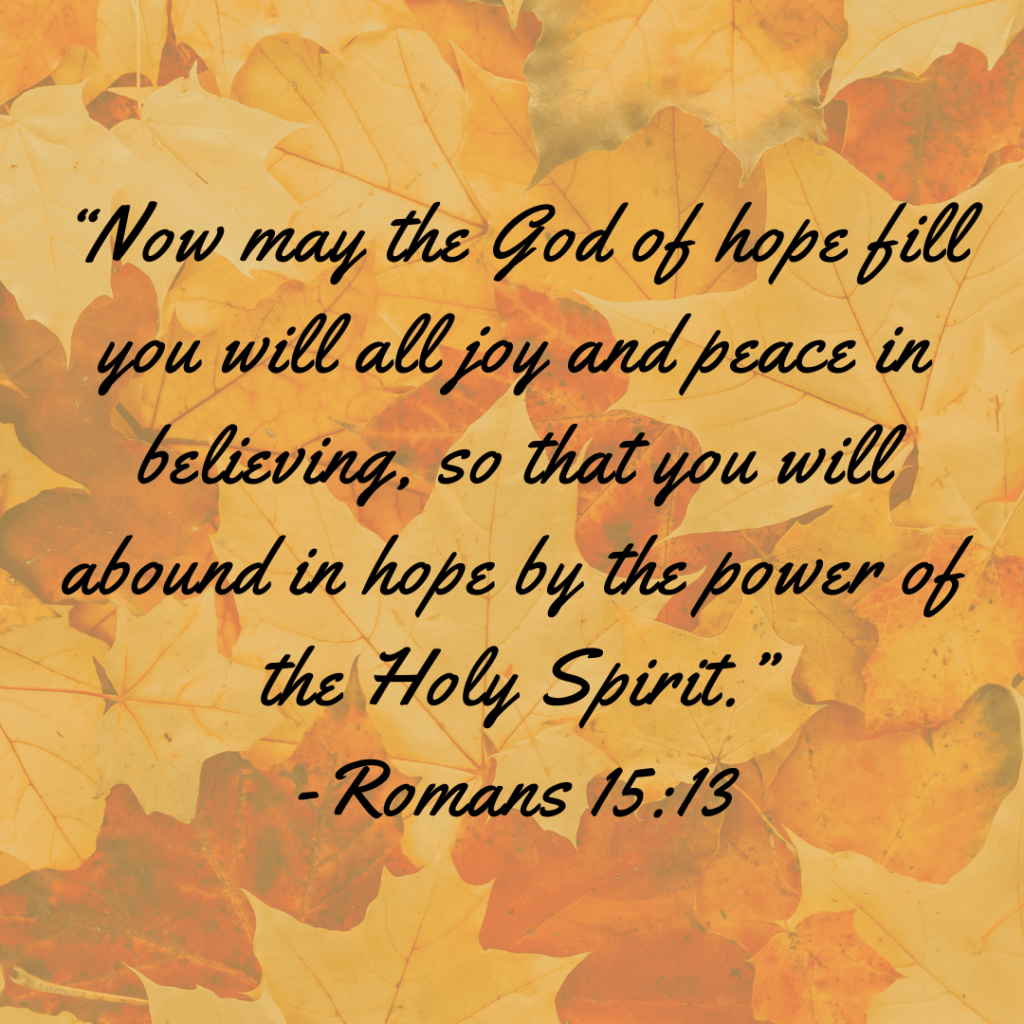
I pray that you would reflect on this Truth with me as we celebrate Thanksgiving and enter into Advent. As a prayer for hope this holiday season, I’ll close with Paul’s words from Romans 15:13: “Now may the God of HOPE fill you will all joy and peace in believing, so that you will abound in HOPE by the power of the Holy Spirit.”
 By Madelynn Orion