
(Or, A Chance To Gush About Xenoblade Chronicles 3)
Once upon a time, I used to be a “story purist.” In other words, I used to believe that books were the unquestioned superior form of storytelling, and dismissed movies, TV shows, and video games as inferior stories. I never thought those visual mediums could come close to matching the development and construction of a book’s story, world, and characters.
How times have changed.
In college, I slowly unraveled that false assumption, coming to enjoy the Marvel movies leading up to Avengers: Endgame and the TV show Agents of S.H.I.E.L.D. I grew in appreciation for Avatar: The Last Airbender, and Gravity Falls, both TV shows that tell fantastic stories with rich worlds and characters. I even recognized that some movies are actually better than the books (namely, How to Train Your Dragon and The Maze Runner trilogy).
Then I got my Nintendo Switch, originally just to play Animal Crossing: New Horizons, but I soon fell in love with The Legend of Zelda: Breath of the Wild and the Xenoblade Chronicles trilogy, both of which taught me that video games can sometimes have amazing stories, the most relatable characters, and the most incredible world-building. It completely changed my perspective on storytelling in ways that have since helped me fall back in love with novel writing. Zelda and Xenoblade are among the most inspiring stories I’ve engaged in over the past couple of years.
Among the video games I’ve played, there’s one specific one that stands out: Xenoblade Chronicles 3. While I love the simplicity of The Legend of Zelda and enjoy the stories of the first two Xenoblade games, Xenoblade Chronicles 3 has become my all-time favorite video game on a level that’s equivalent with how I feel about The Lord of the Rings. Nothing will dethrone The Lord of the Rings as my favorite book of all time, and that’s how I feel about Xenoblade Chronicles 3.

But why? Why this game? Well, I don’t think it’s necessarily a game for everyone, but for me, this game resonated on a lot of the right notes. And that’s what I’m going to break down today, and connect these “right notes” to how it’s helped reenergize my novel writing.
I’ll start with the gameplay, which may be a weird place to begin. After all, with writing, there’s not an equivalent comparison—but just bear with me. Xenoblade Chronicles 3 is the right balance of simple and complex: there’s a lot to learn on the combat level, but it’s fun to figure out, to experiment, and to “build” characters and your team with accessories, gems, arts, etc. For context on how big a deal this is for me, I don’t typically like games with a lot of combat mechanics to keep track of and level up, but this game is an exception because I genuinely enjoy how they’ve designed the flow of battle. I also appreciate how the game eases you into the mechanics.
But what does this have to do with writing? Well, it makes me consider: how easy is it to get acclimated to the world I’ve constructed in my fiction? Is the barrier of entry and learning process about the world fun for readers? Gameplay is a major part of keeping a video game engaging and interesting; you have to explain it in a way that players don’t get overwhelmed but also don’t get bored. In a similar way, this gets me to think about how engaging my books are balanced with the progression of world-building information. I can’t just dump my whole world onto readers from the outset. I need to pace the information in a way that keeps the story moving forward, giving the reader the context they need, while also not making the prose read like a history book.
Next, the characters of Xenoblade Chronicles 3 are also fantastic, and not just the main party. Each side character, down to the most basic NPC, has a distinct and unique personality, and some even have mini-character arcs to experience if you commit to playing through all the side quests (which I recommend—they’re worth it). But the crowning accomplishment of the game’s character development is definitely the main party: Noah, Mio, Eunie, Taion, Lanz, and Sena are done so well. Their interpersonal dynamics are compelling, and each of them play a role in advancing the main story. Not only that, but the way this game weaves their individual character arcs into the overall story is amazing. In fact, each of the six main characters are so well-executed that I have a hard time picking favorites. (Okay, my favorites are Taion and Eunie, but all of them are high on a list of my favorite fictional characters.)
These characters and how their individual story arcs are explored through the overall story is perhaps the most valuable inspiration from this game I’ve applied to my writing. It completely changed the way I think about character and overall stories intersecting, all through just giving me a memorable and well-done example of character development lessons I’ve engaged with and heard for years in writing books and conferences. Xenoblade Chronicles 3 brought to life how characters should be included, should deeply matter to the story, and gave me a whole new angle on how to plot. The game’s example saved me from my Myth-Keepers rut, as I changed my approach to plotting the series. Inspired by Xenoblade Chronicles 3, I approached The Myth-Keepers from a character-first model, mapping out what character arcs I wanted to explore and then piecing together how these threads could weave with other characters’ stories and with telling an overall narrative. While I won’t know how well this pans out until I actually write the whole series, I feel optimistic that my stories will be stronger for it and my characters will be more interesting to my readers. Already, I feel far more confident about this series than I have for years.
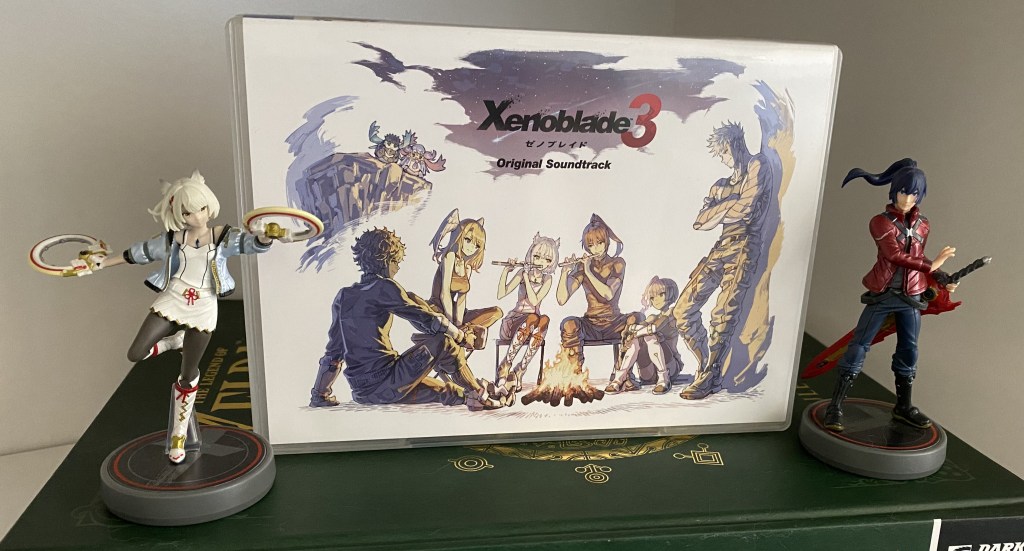
Another major piece of plotting and characters are the themes. In Xenoblade Chronicles 3 there are some beautifully articulated themes, especially ones that I resonate with, that go along with each character arc. All of their individual struggles and thematic resolution also relate to the game’s overall themes of suffering, moving on from past regret, and facing the future with hope and courage. If you know anything about my story, you might immediately recognize why those themes in particular would matter to me. I’ve faced a lot of change in my life, and lately have struggled thinking hopefully about the future. I’ve dealt with a lot of guilt and regret and wondering “what ifs” about my past. This game targets some of those deep struggles in my life and speaks into them in ways that pull me back towards Scripture. Now, this game is not a perfect Gospel presentation, and nor was it intended to be so, but nonetheless, I see God reminding me of Truths about Himself through this game’s story. This, perhaps more than anything, is the reason this game has become my ultimate favorite.
So, how does this impact my writing? It reminds me to write on themes that resonate with me and reflect with how the Lord is teaching me. We’re able to tell the best stories with genuine and honest thematic significance when we pull from our own vulnerabilities. I think I’ve been a little apprehensive to step back into authentic theme expression after publishing an extremely vulnerable book in Our Company of Fools. But Xenoblade Chronicles 3 reminds me how important it is to write from a place of honest, from our own weaknesses and wounds. That is my hope for my writing, that I would return to that method of theme development.
I never thought I’d find so much writing inspiration from a video game. It just goes to show that sometimes, you just need to see things from a different perspective.
Now, if you’ll excuse me, I’m off to write more of The Myth-Keepers while blasting the Xenoblade Chronicles 3 soundtrack.
 By Madelynn Orion