
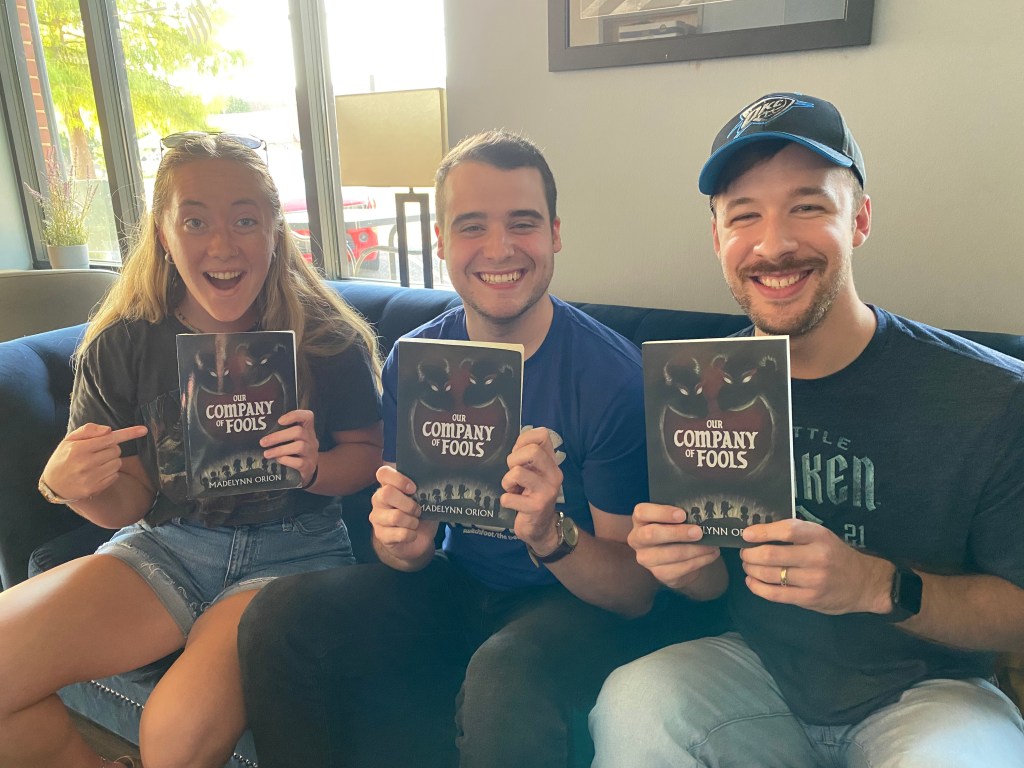
For the first time since it was published in early 2021, I reread Our Company of Fools—with a Book Club. And yes, it was as intimidating as it sounds, even though it was with a few friends. And yet, I was pleasantly surprised by how reading my own novel, now removed from an author’s protective bias by a couple years’ time, encouraged me in my own growth as a writer. By sharing my own reflection on Our Company of Fools, I hope to encourage my fellow writers (and creative souls), too. Our growth as artists in whatever field often goes unseen until we look back, and even then, we need to be humble in our retrospection.

In my experience, those in the writing world often talk a lot about writing process (taking a story from idea to publication), but there seems to be a lack of discussion on how to handle a story after it’s been released to the world. Several authors I follow seem to occasionally reminisce with fondness on their earlier work and/or only engage with it when shouted out by someone else. Most of the time, writers barely mention their past work after a certain point, focusing entirely on what’s upcoming and in progress. Which is common sense. After all, to build a brand or build a career in writing requires continuing to write and keep up audience interest.
Back in 2021, I always felt weird bringing up that I published a book. Even today, it feels odd to talk about, though unlike two years ago, there’s no pressure to market and very few people who will bring it up in conversation. When I published Our Company of Fools, I experienced a sense of relief, a sense of anxiety (more like embarrassed nervousness), and a sense of “What now?”. So much effort goes into creating a novel, and sharing it with others stirs up so many strong emotions, especially when you put a story out there that’s a window into some deep vulnerabilities. I didn’t feel like I had the tools to navigate those feelings as an author. We talk so much about the writing process, and very little about what happens when the book is done.
Which is why I avoided Our Company of Fools for two and a half years. I didn’t want to face that storm of emotions again. Nor did I want to experience potential embarrassment by looking back and finding errors, cringey lines, and scenes that I could now write so much better. I didn’t used to understand writers who said they couldn’t stand to read their earlier work. Sure, I had my fair share of awful early drafts, but they were fun memories for me. When Our Company of Fools came out, I finally understood.
Despite the strange swirl of emotions surrounding my first published novel, when my friends in Subcreators said they’d want to read my book for our annual summer book club, I agreed—with the caveat that everyone needed to be honest with me about their reading experiences. After all, if I think I have any right to be critical of other writers (as I sometimes am in my Reading Recaps), I should certainly be humble about my own work. And I think I needed to return to its pages, to combat my own fears and grow a little more in humility.
So how’d it go? Better than expected. It was challenging in places, yet overall rewarding. It also revealed to me how much I’ve grown as a writer. It brought me face-to-face with the readers who resonate with the story, showing me that this tiny book could still make a positive impact on the people who needed it.
Let’s talk about the challenges of rereading Our Company of Fools. For one, I couldn’t help but read the book with an editor’s brain at least half the time. Some dialogue came across as stiff for me, as did certain descriptors. I’d probably alter a few of the story beats, too, and cut a couple of characters. Some of the novel is also self-indulgent of my own little inside jokes. While I could choose to stay in the embarrassment of not writing the most perfect of perfect novels, it was much more gratifying to recognize those things and mark them as areas I’ve since grown in.
And let me be clear: I wouldn’t take back publishing the book when I did. I still do believe it’s the book it needed to be at the time it was released. To take it back, to try and fix it, well, it still wouldn’t satisfy. Because we keep growing. What I don’t notice in my writing today will bother me next year. There’s no perfect version of this story—or any story I write—that I will ever be able to achieve. Not even Tolkien managed to capture his own perfect vision of Middle-earth in his lifetime. Plus, taking the book back and trying to make it better at this point in its journey would just be a marker of my own pride, my own feeling of needing to hide. All of us have to start somewhere, and from this origin point, I will only continue to grow as a writer. As I said back when I published Our Company of Fools, I needed to let the book go, to lay it to rest, in order to focus on other projects, other stories that will help me grow even more.
With that, after rereading the novel, I am no longer ashamed of the book, as I have admittedly felt from time to time. It’s not a perfect book, but there is a sweetness to it. I still love this story. It still makes me laugh. It still touches me. And the ending? Still moves me to tears and makes the whole journey worth it. The ending of the novel still holds up, and it is still the most precious part of the book. It’s the reason it was published.
But it doesn’t matter so much what I think. The book is no longer just mine. I also have seen that Our Company of Fools resonates with those who relate to its story, to Leah, to the fears of the others within the novel. It is very rewarding to see the book reach those who need it now. I no longer need Our Company of Fools. But others do.
I write this reflection not to boast in my own progress, but as an act of vulnerability, in the hopes that other writers will be encouraged. If you don’t see how you’re growing and progressing now, go back and reread your earlier drafts. Notice what you didn’t see back then about your writing. Write it down so the next time you feel discouraged, you can go back and remind yourself how far you’ve already come. Retrospection is a gift, and a needed one.
I look forward to the day when I’m able to look back on my future novels and see all that they’ve taught me. I’m grateful for Our Company of Fools and how much this little book has taught me. (And I’m even more grateful for the friends who read it alongside me and encouraged me!)
 By Madelynn Orion