
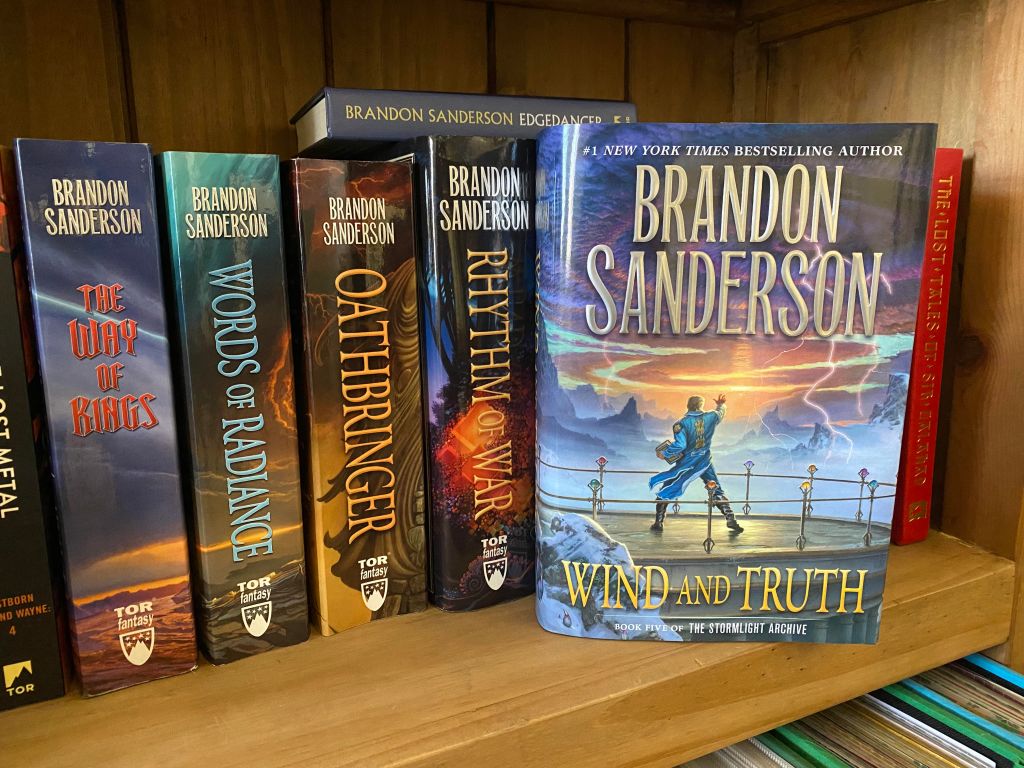
Leading up to the release of Wind and Truth, I reread Brandon Sanderson’s The Stormlight Archive (abbreviated to “Stormlight” throughout).Along the way of revisiting one of my favorite fantasy series, I made some mental notes on how to apply Sanderson’s mastery of fantasy world-building into my own tales and what my fellow fantasy writers might learn from this epic series. I’ll keep my thoughts mostly spoiler-free, though there may be some mild ones for the first couple of Stormlight books.
Sanderson’s world-building and magic-crafting skills are definitely one of his major writing strengths. Pick up any of his novels, and the world and magic are what stands out most. With Stormlight, this is no exception. The world of Roshar—the central setting of Stormlight—has unique geographical features, weather patterns, and rules of physics, all described in vivid and intriguing ways. It’s easy to imagine yourself in the world. Beyond the physical makeup of the world, Roshar also comes to life through its diversity: several different cultures populate the world, adding to the vibrancy and realism of the fictional universe, and creating some story conflict as these differing nations and peoples clash.
The magic system of Stormlight is also incredible. I can’t talk too much about it without heading into spoiler territory, as the discovery of magic is wound up with the larger plot of the series, but it is fascinating, detailed, and very, very cool. While some of the Surges (the name for the magic on Roshar) aren’t necessarily unique among the types of magic in fantasy fiction, the way they are organized, constructed, and work together in Roshar is a unique application. It’s probably my favorite magic system I’ve ever encountered, largely because of how memorable and developed it is.
I’ve only skimmed the surface of Roshar’s rich world, and do need to admit something about it: at times, Sanderson’s world-building can be easy to get lost in (especially if you’re not a hardcore fantasy fan). But I do think Sanderson does another thing really well to mitigate that problem: progressive reveals. This is especially true of the magic system. I like to joke that Sanderson series all start out with the same plot: the world has forgotten how its own magic works and the main character is involved in rediscovering that magic. While one might argue he overuses this trope, honestly, it’s a very useful and practical way to ease a reader into a complex magic system like Stormlight’s because the characters learn the magic alongside the reader.
Another excellent strategy that introduces the world and magic to the reader at a nice pace is how Sanderson incorporates the world’s history into the main plot of Stormlight. While the story of Stormlight is more than just the lost magic and uncovering the mysteries of the past, the world-building elements do majorly impact the unfolding conflicts. Weaving information about the world and magic into the driving action of the story, as Stormlight does, works well because it raises questions about the world’s background that readers are then naturally interested in answering. In other words, information about the world and its magic isn’t forced onto readers; it’s naturally revealed by the story. Discovering more about Roshar becomes compelling because you can’t care about the overall story itself without caring about the world, too: learning who the Knights Radiant were, who the Voidbringers are, what the spren do, and more are all relevant to the main story. While admittedly there are a couple of instances of info-dumping, for the most part, Sanderson does a great job in Stormlight building readers’ curiosity about the world.
Characters are another strength of Stormlight, as the series is built on characters with messy backstories, moments of redemption, and struggles to overcome trauma, especially in the cases of Kaladin, Shallan, and Dalinar. In particular, I appreciate the realism behind how the characters’ struggles are portrayed. Since the Stormlight books are massive, they’re able to take the time to show how healing from trauma and grief is a gradual process with some stumbles along the way. Despite their magical abilities, none of the characters are magically fixed overnight, providing a depiction of personal growth that’s grounded in reality. I appreciate this portrayal and the depth behind the characters and their arcs; they are definitely some of the most well-developed characters I have encountered in fiction.
While my own fantasy stories are fairly different in scope compared to Sanderson’s Stormlight series, I nonetheless see a lot of value in studying the work of one of the greatest modern fantasy writers of our day (or, at the very least, certainly one of the most popular). Even if my worlds are smaller, I can still work to make them compelling, the history relevant to the plot, and the magic system progressively revealed at a pace fit for the reader. And I can certainly work to make my characters deeper, more complex, and more realistic in their struggles. I feel very inspired by rereading The Stormlight Archive, and it was a great series to revisit as I work on revising The Myth-Keepers.
P.S. Full Wind and Truth review coming soon! Stay tuned.
 By Madelynn Orion