
This year, I finally finished The History of Middle-earth series, a 12-book dive into the development of Tolkien’s writing of The Silmarillion and The Lord of the Rings across the span of his life, edited and with commentary from Tolkien’s son Christopher. It took me ten years to read through them all; as much as I love Tolkien, they can be a little dense on account of the thorough explanations, and repetitive, as you do read the same stories over and over, sometimes with only minor changes. Still, it was a fascinating series to read, and I like to think of it as a biography of Tolkien told through his writings.
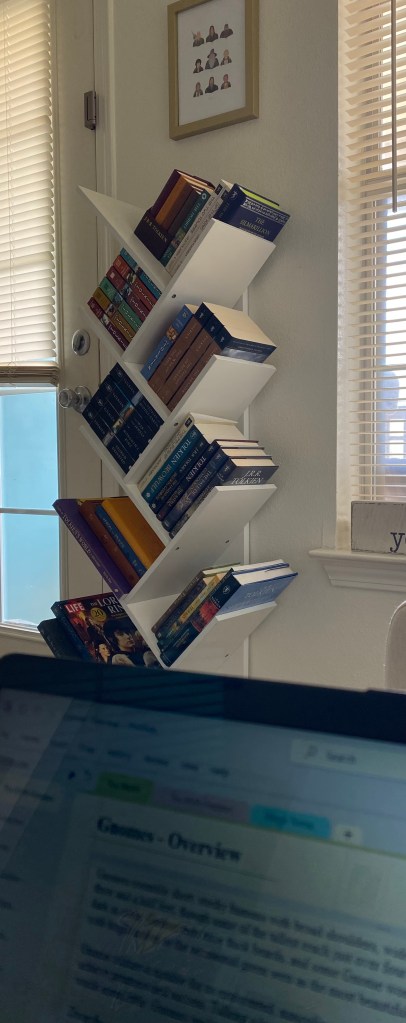
I also read The Fellowship: The Literary Lives of the Inklings by Philip Zaleski and Carol Zaleski this summer, and while Tolkien was not the only one featured, the details about his life story captivated me most. I had known some details about Tolkien’s life, many from reading The History of Middle-earth,but the Zaleskis’ book filled in the gaps for me.
I am very grateful for the impact of Tolkien’s story on my own writing journey. I’ve gained a lot of encouragement from him as a writer, especially as I read through The History of Middle-earth. First, it’s helpful perspective to recognize just how long a labor it was for him to actually produce The Lord of the Rings (LOTR). It’s easy to get caught up in LOTR’s fame today, but far more encouraging as a writer to take a step back and recognize how arduous a process it was for Tolkien to write it, not to mention how many times he almost walked away from the project entirely. This story about my favorite book’s existence and the struggle it took for Tolkien to actually complete it is very encouraging for me as I continue to wrestle over long-term projects that haven’t come to fruition yet. Tolkien reminds me to be patient with myself.
Beyond LOTR, Tolkien was also a life-long writer of his mythos, another fact that inspires me. The Silmarillion took shape over the whole course of his life. While I hope that I am able to finish my own stories before I die, unlike The Silmarillion, I at least take away an appreciation and a peace about taking a long time to write something you care about. Tolkien’s commitment to his stories stretching over his lifetime reminds me that there is no set, singular timeline for getting a story out into the world.
Not only did it take Tolkien a long time to write his stories, but his process was far from linear, and his stories were subject to a ton of changes. The History of Middle-earth in particular highlights how much Tolkien revised his work, tried to work through problems, and persevered in trying to create the best story he possibly could. I’ve noticed a similar pattern in my own writing: a ton of revisions for the same series time and time again as I try to puzzle out what works, where plot holes are, and try to tell the best possible stories I can with the characters, world, and plot elements swirling in my head. Tolkien’s example encourages me embrace the revision process; I’m not going to get the story right on the first time, and that’s okay.
Tolkien also loved his world. Perhaps more accurately, he loved his languages. He used those languages to bring his world to life. He had a vision for his mythos, and that motivated him to try and present it in the clearest way. His passion for his world inspires me to let joy into my subcreation, in creating new fictional worlds as a reflection of our Creator God, and letting that passion for the imaginative world drive the creation and writing process. While Tolkien’s world and mine are detailed in different ways—Tolkien’s attention to geography and linguistic differences grounds Middle-earth with a sense of realism, whereas I’m more attuned to rich and fantastical cultures and detailed magic lore, giving my worlds a whimsical feel by comparison—the passion we both feel for our respective subcreations is shared.
Finally, Tolkien’s life also speaks to our need for community as writers. Tolkien had the Inklings, and C. S. Lewis in particular was instrumental in bringing us LOTR today. That singular example shows how powerful community can be in shaping a story, in bringing a story to life, and in reviving a story. It encourages me to try and open up more, to share my work with others, and to find those who can constructively breathe encouragement into the stories I write.
All in all, I am grateful for Tolkien’s legacy. His work is a gift to me as a writer, and I absolutely see his impact directly affect my own work and how I think of myself as a writer.
 By Madelynn Orion